|
||||||||||||||||||||||||||||||||||||||||||||||
Lone Scouts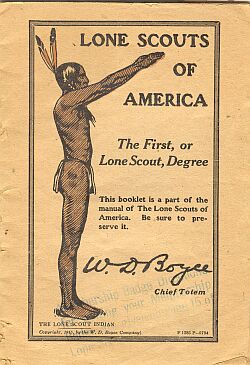 Lone
Scouts have been around since 1915 when William D. Boyce organized the
Lone Scouts of America (LSA). He had noticed that rural boys were
being left out of Scouting because they did not live near a town or could
travel to a Scout Troop in the nearest town. As a Lone Scout, a boy
could enjoy Scouting. They had a whole set of requirements they could
meet on their own. They had, in addition, a strong program of writing
and correspondence. W. D. Boyce was the Chief Totem. Lone
Scouts have been around since 1915 when William D. Boyce organized the
Lone Scouts of America (LSA). He had noticed that rural boys were
being left out of Scouting because they did not live near a town or could
travel to a Scout Troop in the nearest town. As a Lone Scout, a boy
could enjoy Scouting. They had a whole set of requirements they could
meet on their own. They had, in addition, a strong program of writing
and correspondence. W. D. Boyce was the Chief Totem.
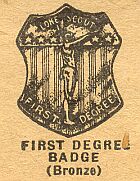
Lone Scouts could achieve recognition in three ways in the Lone Scouts of America program: Degree Work, Literary Achievement, and Promoting the Organization. On the left the the first booklet, published on October 30,1915, to help a Lone Scout earn the First, or Lone Scout, Degree. We have been able to find where many boys in West Texas were Lone Scouts and at least ten of them achieved the rank of Eagle Scout. Records of Lone Scouts in West Texas only existed after the program became an official part of the Boy Scouts of America in 1924 and local councils registered the boys in their council. Prior to 1924, they were registered with the Lone Scouts of America and followed the achievement program of the Lone Scouts of America. By early 1924, Boyce determined that he could no longer subsidize the organization, so he merged it with the Boy Scouts of America in March. There were 490,000 Lone Scouts in 1922, but only about 45,000 of them transferred to the Boy Scouts of America. The BSA had to recruit them and that was not an easy task in the rural areas. And in many parts of the country, including West Texas, local councils had not been formed. Many of the Lone Scouts lived in Canada, Puerto Rico and in other countries. By 1930, the Lone Scout program had dropped to about 4,000 members in the Boy Scouts of America. Lone Cub Scouting and Lone Scouting still exist today, as official programs of the Boy Scouts of America, but there are only a few hundred members now. However, boys being home school can be Lone Scouts. There are many other reasons that a boys are eligible to become Lone Scouts including children of American citizens who live abroad, exchange students who live outside the United States, boys with disabilities, boys in rural communities, sons of migrant farm workers, boys who have jobs that conflict with troop meetings, boys who have alternate living arrangements with parents who live in different communities and boys who are unable to attend unit meetings because of life threatening communicable diseases. Every boy must have an adult, 21 years of age or older, who meets the adult membership requirements and agrees to serve as the boy's Lone Scout friend and counselor. Since being merged with the Boy Scouts of America, and after 1926, the boys followed the regular Boy Scout Advancement program. Prior to that time, they had their own achievement recognition program Achievement Recognition
To look at all the requirments for the First, or Lone Scout Degree, you can go to the following pages of the booklet: | 2-5 | 6-9 | 10-13 | 14-17 | 18-21 | 22-25 | 26-29 | 30-31 | We do not know who, if any
Lone Scouts, followed or completed the Degrees of the Lone Scouts of America.
But we do have a list of the ten Lone Scouts who became Eagle Scouts in
West Texas. They are:
Lone Scout Brothers Did Well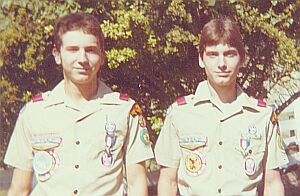 The
two Miles boys, Aaron and Mark, became Lone Scouts because there was no
troop in Barksdale and they lived some ten miles out of town toward Rocksprings.
They worked on their advancement at home and went to summer camp at Camp
Fawcett with Troop 227 of Rocksprings, TX. Camp Fawcett was located
just a mile north of Barksdale. They also participated in Camporees
and in 1984 went with the Concho Valley Council's contigent ten day canoe
trip to Bissett, Canada where they canoed over 110 miles. There they
qualified for the World Crest Award and the 50 Miler Award as well as the
privilege to wear the special "Northern Expedition" polar bear patch of
the BSA National High Adventure program. The
two Miles boys, Aaron and Mark, became Lone Scouts because there was no
troop in Barksdale and they lived some ten miles out of town toward Rocksprings.
They worked on their advancement at home and went to summer camp at Camp
Fawcett with Troop 227 of Rocksprings, TX. Camp Fawcett was located
just a mile north of Barksdale. They also participated in Camporees
and in 1984 went with the Concho Valley Council's contigent ten day canoe
trip to Bissett, Canada where they canoed over 110 miles. There they
qualified for the World Crest Award and the 50 Miler Award as well as the
privilege to wear the special "Northern Expedition" polar bear patch of
the BSA National High Adventure program.
Both Scouts became members of the Wahinkto Lodge of the Order of the Arrow. Although Lone Scouts could not become members of the OA, they did, through dual registration with Troop 227 and were elected by that Troop's Scouts. Both brothers were very active in lodge activities. Aaron Miles was to later became a Vigil member of the lodge in 1985. Here is a list of the known Lone Cubs and Lone Scouts that were a member of the Comanche Trail Council as recreated from their Lone Scout history files and a Lone Scout Rally held in Cisco, TX in 1927 | Lone
Scouts of Comanche Trail Council | Lone
Cubs of Comanche Trail Council | Lone
Scout Rally - 1927 |
Updated: January 6, 2005 |